
Caputo Pizzeria vs Nuvola: Which Flour is Right for You?

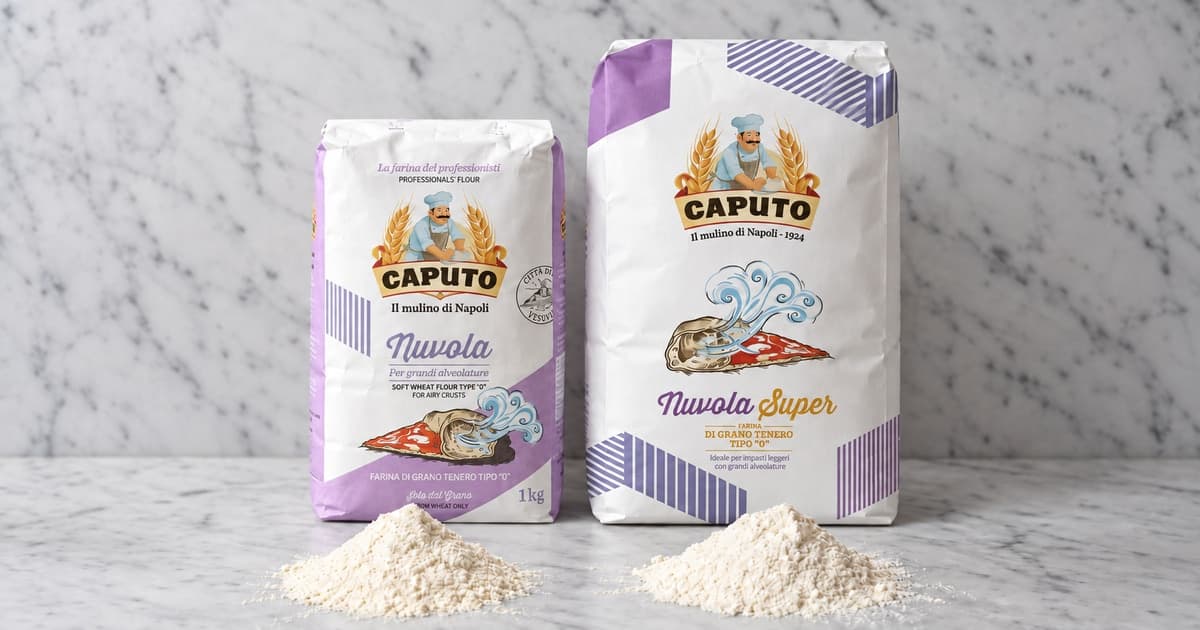
Caputo Pizzeria and Nuvola both have 12.5% protein, similar W values and the same declared P/L range. Yet Caputo points them toward slightly different jobs. Pizzeria is chiefly for classic Neapolitan pizza, while Nuvola is for doughs where more volume and a more open cornicione (the pizza rim) matter.1,3,4
Pizzeria is the dependable classic. Nuvola is the move toward a bigger, puffier rim.
That does not mean Pizzeria cannot make a light pizza, or that Nuvola automatically produces a huge cornicione. Flour gives you a set of possibilities.
In short
- Pizzeria is the classic starting point. I would choose it for Neapolitan pizza, moderate hydration and a short bake at high heat.
- Nuvola gives you more room for water and volume. It suits a more open rim, contemporary pizza, focaccia or pizza in a pan (pizza in teglia).
- Neither flour has its own clock. Fermentation time comes from the whole plan, not the bag name or W alone.
- Type 00 and type 0 do not tell you how strong a flour is. Check the product and its W, not just the type printed on the pack.5,6
- Hydration, fermentation, shaping and oven determine how you use the flour. Swapping bags alone will not make a bigger cornicione.
Caputo Pizzeria: the classic starting point
Pizzeria is a type 00 flour made for classic Neapolitan pizza. Caputo gives it W 260–280, 12.5% protein and P/L 0.50–0.60. The same figures appear on Caputo's current 1 kg, 5 kg and 25 kg packs.1,2 Find the full details in the Mulino Caputo Pizzeria flour card.
Pizzeria specifications
- Type: 00
- W strength: 260–280
- Protein: 12.5%
- P/L: 0.50–0.60
- Pandough working hydration: 58–65%
I would choose Pizzeria for:
- classic Neapolitan pizza
- moderately hydrated dough
- high-temperature gas or wood-fired ovens, around 425°C+
- a process where classic dough character matters more than maximising rim volume
I would not give Pizzeria a fixed limit such as “8–24 hours”. Caputo also offers it as a flour for longer fermentation; real duration depends on temperature, yeast quantity and the whole schedule.2
Caputo Nuvola: toward a more open rim
Nuvola means “cloud” in Italian, and the name gets the product's intention right. Caputo describes it as flour for light doughs with high volume and large bubbles. Its 1 kg version lists focaccia, pizza in a pan and contemporary pizza.3,4 Find the full details in the Mulino Caputo Nuvola flour card.
Nuvola has W 270–290, a little higher than Pizzeria, with the same declared 12.5% protein and P/L 0.50–0.60.3,4
Nuvola specifications
- Type: 0
- W strength: 270–290
- Protein: 12.5%
- P/L: 0.50–0.60
- Pandough working hydration: 60–70%
I would choose Nuvola for:
- a light, puffy rim with a more open structure
- contemporary pizza
- dough run at higher hydration
- focaccia and pizza in a pan
- a home oven that does not reach very high temperatures
That final point does not mean Nuvola magically fixes the limits of a home oven. With a longer bake, hydration, baking-surface temperature and browning still need attention.
PRO TIP If you are moving from Pizzeria to Nuvola for the first time, do not change the flour, hydration, fermentation and mixing method all at once. Start around 64–65%, keep your usual schedule, and see what the dough itself does. Add water only afterwards.
Type 00 and type 0 do not tell you how strong the flour is
Type 00 or 0 describes how refined the flour is, not its W strength. A common recipe mistake is to call simply for “00 flour” as though every bag were interchangeable. They are not. A flour that is too weak for a demanding dough can be the difference between a beautifully risen rim and a sticky disc that tears while you shape it. Check the specific flour and its W, not just the type on the pack.5,6
Which should you choose?
Choose Pizzeria if you:
- want classic Neapolitan pizza
- usually work around 58–65% hydration
- do not need Nuvola's extra range
- use a high-temperature oven
- want a straightforward reference point for further experiments
Choose Nuvola if you:
- want a light, puffy rim
- are comfortable working around 65–70% hydration
- make contemporary pizza, focaccia or pizza in a pan
- have a home oven that does not reach very high temperatures
- want to work across a wider hydration range
There is no hard boundary between these uses. You can make contemporary pizza with Pizzeria and classic Neapolitan pizza with Nuvola. The point is which flour gives you the more comfortable starting point for the process you have planned.
What about fermentation time?
Caputo itself describes professional Pizzeria as suitable for long fermentation.2 On the Nuvola page, it gives a classic Neapolitan dough as an example with a process of about 72 hours, including 48 hours in the fridge and 24 hours at about 22°C.3 That is Caputo's process example, not a universal time requirement for Nuvola.
In practice, timing is set together by:
- dough and room temperature
- fridge temperature
- yeast quantity and type
- hydration
- preferment proportion
- when you divide the dough
W is therefore one parameter in the plan, not a clock. If you use biga or poolish, also read Pizza preferments: poolish, biga and sourdough.
If you need an even larger strength reserve for a more demanding process, read Caputo Nuvola vs Nuvola Super: Which Flour Should You Choose?. Nuvola Super has W 320–340 and 13.5% protein, so it is a different product from regular Nuvola.
Home oven: more water and better browning
A typical Neapolitan pizza bakes for 60–90 seconds at roughly 430–480°C. A home oven runs much cooler, so the pizza stays in longer.11 In that situation, I would choose Nuvola. Its higher working hydration range lets you put more water into the dough; during the longer bake that water evaporates and helps limit drying in the base and rim.
At lower temperatures it is also worth enriching the dough with a browning aid, such as sugar, honey, malt syrup or a small amount of diastatic malt powder. Active enzymes in diastatic malt increase the sugars produced as starch breaks down, which is why it is used sparingly.7,8
The Pandough calculator will calculate the right quantity of browning aid. It also gives an approximate baking time from your oven temperature and chosen baking surface.10
For a home oven, I especially recommend . Preheat it with the oven, then it gives that stored heat quickly to the pizza base. Tony Gemignani, author of The Pizza Bible, even recommends a two-steel arrangement. The pizza starts on the upper steel and then moves to the lower one, giving you more control over the base.12
Compare these flours in a recipe
Caputo Pizzeria and Nuvola in the calculator
Přepínej mezi Caputo Pizzeria a Caputo Nuvola a sleduj, jak se mění optimální parametry těsta.
This is Farina Prima, the flour-first method. Start with the actual flour, then match the water, yeast, temperature, time and oven to it.
What would I choose for a first try?
For classic Neapolitan pizza at moderate hydration, I would choose Pizzeria. For a lighter, more open cornicione at 65–70%, I would choose Nuvola. The process matters, not your experience level.
FAQ
Sources
- Mulino Caputo, "Pizzeria 1kg". Current producer specification: type 00, 12.5% protein, W 260–280, P/L 0.50–0.60. Accessed 2026-09-21.
- Mulino Caputo, "Pizzeria 25kg". Specification and stated use for longer fermentation. Accessed 2026-09-21.
- Mulino Caputo, "Nuvola 1kg". Current producer specification: type 0, 12.5% protein, W 270–290, P/L 0.50–0.60. Accessed 2026-09-21.
- Mulino Caputo, "Nuvola 5kg". Product description as flour for light doughs, high volume and large bubbles. Accessed 2026-09-21.
- Mulino Padano, "How to choose the best flour: the complete guide". Explains the Italian flour-type classification. Accessed 2026-09-21.
- Mulino Padano, "How to choose flour for your pizza". Distinguishes flour type, particle size and rheological parameters. Accessed 2026-09-21.
- Kim et al., "Effects of Combined α-Amylase and Endo-Xylanase Treatments on the Properties of Fresh and Frozen Doughs and Final Breads", Polymers, 2020. Effects of alpha-amylase and reducing sugars on crust colour.
- Ral et al., "Engineering high α-amylase levels in wheat grain lowers Falling Number but improves baking properties", Plant Biotechnology Journal, 2016. Link between extra sugars, alpha-amylase activity and baking browning.
- Pandough flour catalogue, Caputo Pizzeria and Caputo Nuvola. The 58–65% and 60–70% ranges are Pandough working recommendations, not Caputo specifications. Accessed 2026-09-21.
- Pandough knowledge base, “Crust Lacks Browning” and current calculator documentation. The browning-aid card appears for lower-temperature ovens and supports sugar, honey, non-diastatic malt and diastatic malt powder. Accessed 2026-09-21.
- Associazione Verace Pizza Napoletana, "International Regulations". Baking temperature of 430–480°C and time of 60–90 seconds. Accessed 2026-09-21.
- Tony Gemignani, "Making Pizza At Home, The Tony Gemignani Way – Part 1". Discusses baking steel and a two-steel setup in a home oven. Accessed 2026-09-21.
* Jako partner programu Amazon získává Pandough provize z kvalifikovaných nákupů.
Co je Pandough?
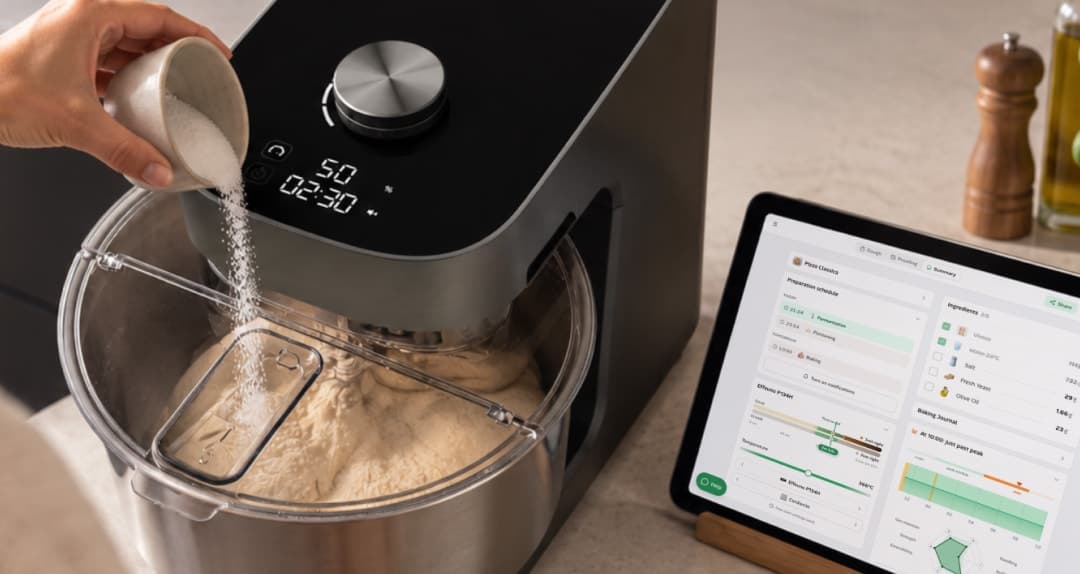
Pandough je správce těsta, který sestaví přesný plán podle tvé mouky, kuchyně, pece a časových možností.
Vyzkoušet kalkulačku