
Pizza Canotto: what it is and how to get a high rim at home
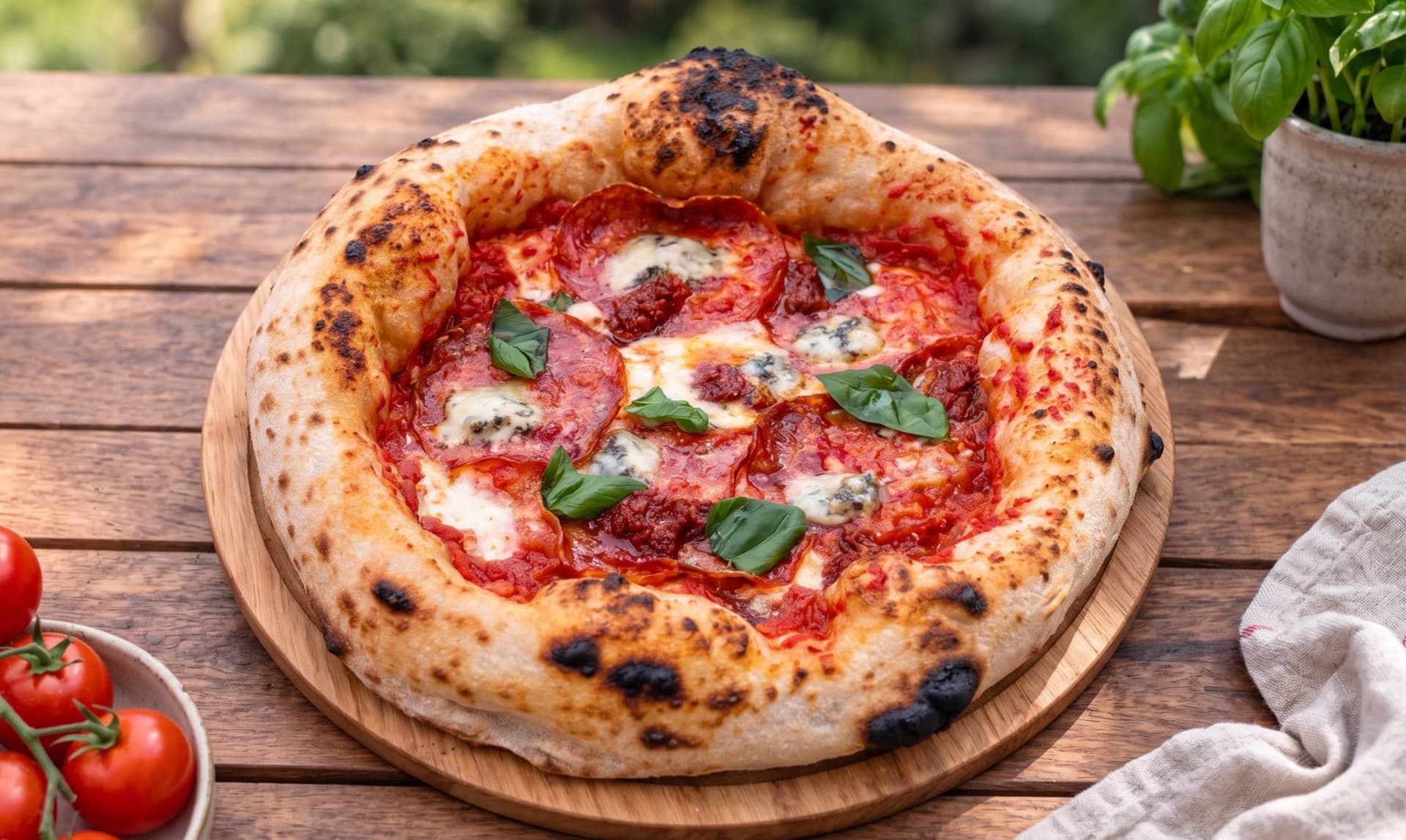
A tall, almost hollow rim and a thin center. Pizza Canotto looks dramatic, but bumping hydration to 70 or 75% often leaves you with sticky dough or a huge, gummy cornicione.
Canotto is not a number on the hydration slider. It is what you get when flour, water, fermentation, gluten, opening, and the bake fit each other.
In short
- Canotto grew out of a new wave of Neapolitan pizza in Campania in the early 2010s. The tell is a very highly developed cornicione.1
- Pizza napoletana contemporanea is a wider category. Not every contemporanea pizza is Canotto.2
- You need flour strong enough for the hydration and fermentation time you chose. "Strongest available" is not "best".
- More water softens the dough and can help the rim rise. High hydration alone does not make a puffy rim.3
- High heat helps oven spring, the sudden expansion in the oven. A wet, thick rim also needs time to bake through.4
Where did Canotto come from?
Italian sources describe a group of young pizzaioli around Naples and Caserta, including Carlo Sammarco, Diego Vitagliano, Salvatore Lioniello, Vincenzo Capuano, and Raffaele Bonetta, who started pushing harder on flour, fermentation, and rim structure.1
La Cucina Italiana puts Sammarco and Vitagliano's experiments around 2013. Vincenzo Pagano at Scatti di Gusto says the name "canotto", Italian for a dinghy or inflatable kayak, was a better-sounding stand-in for Sammarco's earlier word "gommone".1
In 2017 a filing for the mark "Pizza Canotto" was described in public. Later Italian coverage treats "Pizza a Canotto" as a registered mark linked to Carlo Sammarco.5 That does not lock down the technique of making a high rim. The mark is the name.

Why "contemporanea"?
Traditional "Pizza Napoletana" TSG has a fairly precise reference point. The specification includes a rim 1 to 2 cm thick and a very short bake, 60 to 90 seconds, with a deck around 485°C.6
"Pizza napoletana contemporanea" has no similar disciplinare. It is a looser name for current readings of Napoletana that change flours, fermentation, opening, preferments, or the proportions of the pizza.
Canotto is one of the most recognizable branches of that current, not a synonym for it. Italian media also file pizzas under contemporanea whose rims do not look like Canotto at all.2
Is Canotto actually light and fluffy?
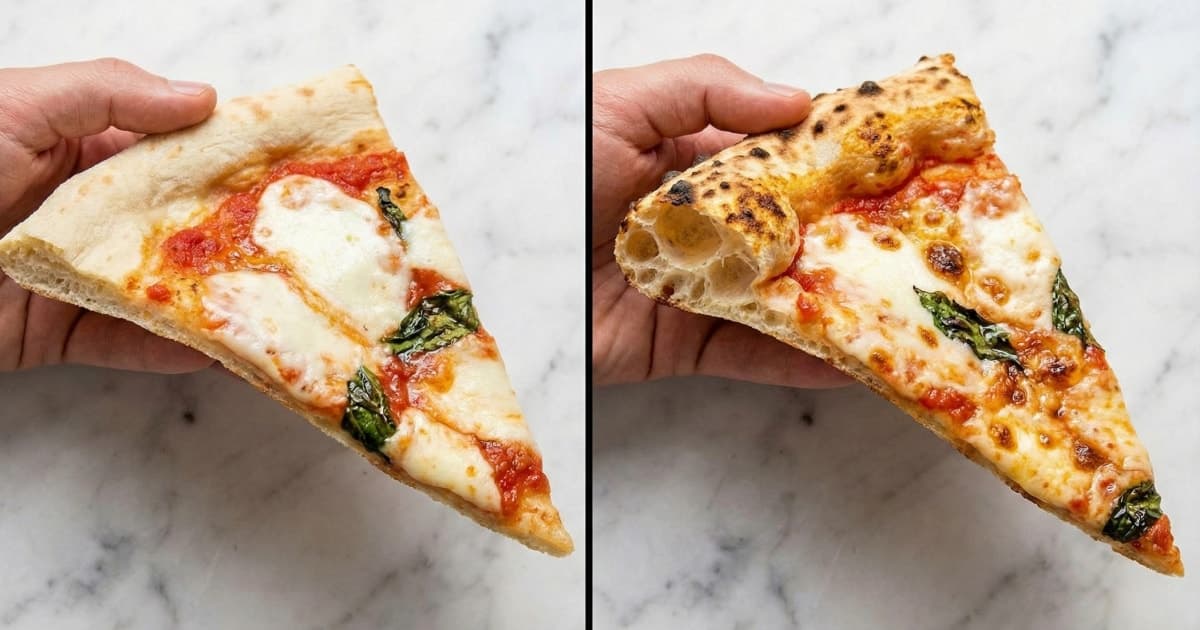
Fluffy, yes. A well-made rim has a lot of volume for relatively little dough, because gluten holds the gas in it. "Light" needs a caveat: large bubbles do not cut the mass of the dough ball, and they do not make the pizza easier to digest. They change structure and how it eats.
That is also why Canotto travels well on Instagram and TikTok. A huge rim, leopard spotting, and a cross-section full of big holes is a one-second picture. NPR already noted in 2019 that the style fits Instagram culture and visual "wow".7
Five things that actually build a high rim
- Flour has to match the water. At high hydration you still need dough that can hold the gas. In some studies, adding water clearly lowered the dough's mechanical strength and spring.3
- Raising hydration on medium or even strong flour can backfire, because the network will not hold the extra water.
- Fermentation has to finish at the right moment. You need gas, and a network that can still hold it. Wet, over-fermented dough can look spectacular in the box and collapse when you open it.
- Do not push the gas out of the rim. Open the ball from the center and leave the outer ring as untouched as you can. If you squeeze the gas out, the oven will not put it back.
- You need a strong heat source, not always the maximum temperature. A very wet, tall rim has more water to drive off. A very short, aggressive bake can scorch the surface while the inside stays wet.
PRO TIP Cut the first cornicione after the bake. If the outside is dark and the inner walls of the large holes are shiny, sticky, and gummy, bake the next pizza cooler and a little longer.
Customize this recipe
Switch between Caputo Nuvola and Molino Quaglia Petra 5037 Unica and watch the optimal-dough parameters change.
Adjust hydration to your oven
A wetter dough is baked cooler and longer. The engine drops surface temperature as hydration rises, then lengthens the bake so the crumb can set. That is why a 90-second launch at high heat can brown a drier Napoletana and still leave a 78% Canotto rim gummy.
Common mistakes
| What you see | Likely cause | What to change |
|---|---|---|
| Dough spreads and sticks badly | Too much water for the flour and process | Lower hydration or pick a flour that fits the plan |
| Beautiful outside, gummy inside | Bake too short for that water and rim geometry | Lower the temperature and lengthen the bake |
| Balls rise, then collapse | Fermentation went too far | Shorten time, cut yeast, lower temperature or hydration |
| Rim stays low at 70% or 75% | Too little gas, a weak network, or gas squeezed out while opening | Check fermentation, gluten development, and opening |
| Dough is strong but hard to stretch | Flour is too strong for the process, or the dough needs rest | Do not pick flour only by the highest W |
Start from the flour, not the photo
If you want Canotto at home, do not start with "how do I get to 75%?". Start from the flour you have, kitchen temperature, real fridge temperature, and what the oven can do.
That is Farina Prima. Open the Pandough calculator, pick flour and oven, and only then see how far you can push hydration without shoving the dough out of a sensible range.
On the first bake watch three things: whether the ball keeps tension, whether the rim holds gas while you open it, and whether the crumb is baked through. A high cornicione is the result of those decisions, not a separate ingredient.
Open a Canotto plan at 78% hydration
Recipe: pizza canotto • Flour: molino quaglia petra 5037 unica • 78% hydration
FAQ
Sources
- Lara De Luna, "Quei bravi ragazzi che amano il canotto: la nouvelle vague della pizza", la Repubblica, 2019. Leonardo Ciccarelli, "La rivoluzione della pizzeria: quel giorno in cui è nata la pizza a canotto", Cookist, 2020. "Cena a quattro mani con i Maestri dell'Impasto", La Cucina Italiana. Accessed 2026-09-10.
- Lara De Luna, "Pizza Briatore: tutte le tipologie di pizza", la Repubblica, 2022. Vincenzo Pagano, "Le 10 regole che fanno della pizza canotto una vera pizza contemporanea", Scatti di Gusto, 2019. Accessed 2026-09-10.
- Mani K., Trägårdh C., Eliasson A.C., Lindahl L., "Water Content, Water Soluble Fraction, and Mixing Affect Fundamental Rheological Properties of Wheat Flour Doughs", Journal of Food Science, 1992. DOI 10.1111/j.1365-2621.1992.tb11298.x. Yang et al., "Effects of vacuum degree, mixing speed, and water amount on the moisture distribution and rheological properties of wheat flour dough", Journal of Food Science, 2021. DOI 10.1111/1750-3841.15752.
- Falciano A., Moresi M., Masi P., "Phenomenology of Neapolitan Pizza Baking in a Traditional Wood-Fired Oven", Foods, 2023, 12(4), 890. DOI 10.3390/foods12040890.
- Walter Caputo, "'Pizza Canotto' è un marchio in attesa di registrazione", Cibo al Microscopio, 2017. Cookist, 2020. la Repubblica, "Le migliori 15 pizzerie gluten free", 2025. Accessed 2026-09-10.
- European Commission, Commission Regulation (EU) No 97/2010, specification for "Pizza Napoletana" TSG. Accessed 2026-09-10.
- Richard Morgan, "Naples Rolls Out A Fine-Tuned Dough, And The New 'Cloud Pizza' Is Born", NPR, 2019. Accessed 2026-09-10.
- Codină G.G., Mironeasa S., Voica D.V., "Influence of Wheat Flour Dough Hydration Levels on Gas Production During Dough Fermentation and Bread Quality", Food and Environment Safety Journal. MacRitchie F., "The Liquid Phase of Dough and Its Role in Baking", Cereal Chemistry, 1976.
- Mulino Caputo, "Farina Nuvola". Manufacturer specifications: Tipo 0, protein 12.5%, W 270/290, P/L 0.50/0.60. Accessed 2026-09-10.
- Molino Quaglia, "Petra 5037 Unica". Type 0. Listed W 300/340. Pandough catalog protein about 13%. Accessed 2026-09-10.
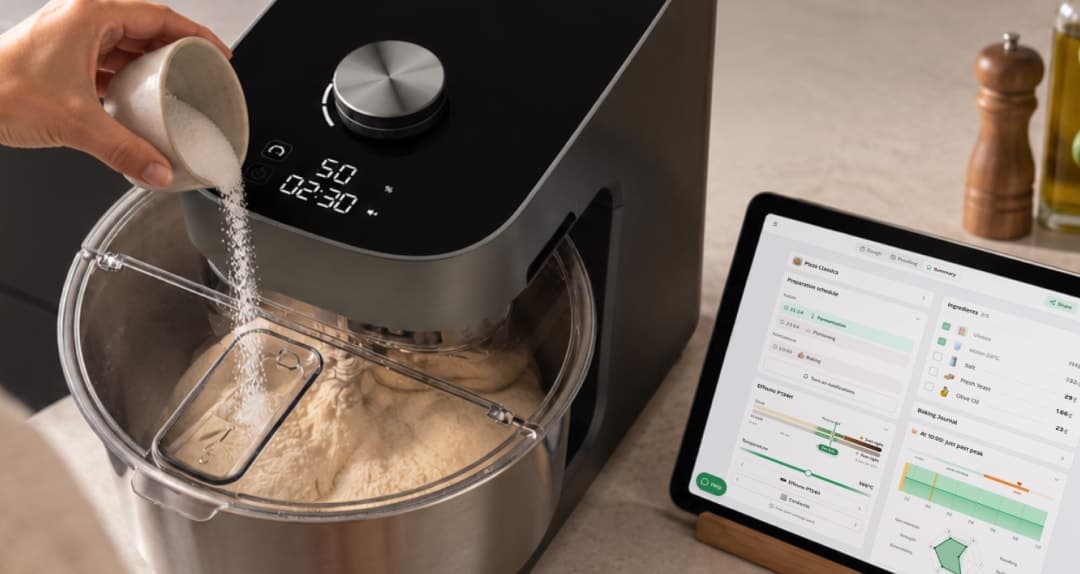
What is Pandough?
Pandough is a dough manager that builds a precise plan around your flour, kitchen, oven and schedule.
Try the calculator