

How to Freeze Pizza Dough: Balls, Thawing, and How Long It Keeps
In short
- Yes, you can freeze pizza dough. After thawing it is good, but not identical to fresh: the yeast and gluten lose some strength.
- Freeze shaped balls before the dough has a chance to over-proof. Never freeze over-proofed dough.
- You have three formats: balls (best quality), rolled-out rounds (faster) and base with sauce (fastest, straight from the freezer).
- Best used within a month. Up to 2–3 months it is still usable if your freezer holds a steady -18°C.
- Thaw it slowly: 12–24 h in the fridge, then 1–2 h at room temperature.
Can you freeze pizza dough?
Yes, and it usually works well. At -18°C the yeast goes dormant and fermentation stops, so the dough doesn't over-proof on you. It's handy when you make a bigger batch to keep on hand, or want a ready base for a quick pizza.
It helps to be honest about what happens inside. Ice crystals damage the gluten network, and some of the yeast cells die. After thawing the dough is a little weaker and rises more slowly than fresh. In a study of bread dough, yeast viability dropped only slightly after two weeks at -18°C, but the dough's mechanics changed clearly: its elasticity and relaxation time fell [1]. The losses grow with storage time [2]. So frozen balls are convenient and tasty, but the best fresh pizza still comes from dough that never saw the freezer.
When to freeze: the right moment
Guides disagree here, and it's worth knowing. King Arthur recommends freezing after the first rise, once the dough has doubled, then dividing and packing it [3]. On the other hand, balls frozen right after shaping have more yeast "in reserve" for after thawing, because they haven't spent any energy on fermentation yet. There's no single deciding rule, but one thing is certain: don't freeze over-proofed dough, because it loses its spring and its strength for the final rise.
For Neapolitan-style dough we suggest a simpler plan:
- Mix the dough according to your recipe.
- Give it a short rest at room temperature and divide it into portions, one per pizza.
- Shape the balls and freeze them right away, before they visibly start to rise.
- The rest of the fermentation happens during thawing in the fridge and the rest afterwards in the warm.
If you plan a long cold ferment in the fridge, freeze the balls before it, not after. A ball that has fermented for many hours already has relaxed gluten, and freezing will weaken it further.
Yeast: how much and which kind
Some of the yeast survives freezing and some doesn't, especially over longer storage. Makers of frozen dough use freeze-tolerant yeast strains [4], which a home baker doesn't have. So we help ourselves with quantity.
- If you use the dough within 2–4 weeks, the usual dose is normally enough.
- For longer freezing, use a little more yeast, starting with about 20–50% extra. This is our practical tip, not a value from research, because nobody publishes a single universal figure.
- Freeze one test ball first and see how it rises after thawing. A dose that is too small is the most common reason frozen balls rise by only about half.
Fresh and dry yeast behave differently in the freezer, and sources don't agree on which is better. Pick one and stick with it so you can compare results.
A small note on sugar. A pinch of sugar (about 1%) feeds the yeast after thawing, but it also browns the bottom more. In an oven where the bottom already burns easily, don't overdo it.
Three ways: balls, rounds, base with sauce
You can freeze a portion of dough in three formats. They differ in how fast they later bake, how much freezer space they take, and the quality of the base.
| Balls | Rolled-out rounds | Base with sauce | |
|---|---|---|---|
| What you freeze | shaped balls | dough rolled into rounds | par-baked base spread with sauce |
| Base quality | best | good | slightly less crisp |
| Freezer space | least | more | most |
| Before baking | thaw 12–24 h | thaw briefly | bake straight from the freezer |
| Who it's for | the default choice | when time matters | pizza "right now" |

- Balls are the default choice: they give the best quality and take the least space. Shape them, brush with oil and pack them (details below).
- Rolled-out rounds speed up baking. Layer them with baking paper so they don't stick together, but they take more freezer space.
- The base with sauce is the fastest option. Roll out the dough, par-bake it dry for 2–3 minutes so the sauce doesn't soak the base, spread a thin layer of sauce and let it cool. Freeze the base flat, and once firm move it to a bag. Bake it straight from the freezer, adding only cheese and the rest of the toppings.
Packing, step by step
Whatever format you choose, good packing decides whether the dough survives in good shape.
- Brush with oil. Coat the balls with a thin layer of oil, which prevents sticking and stops the surface from drying out.
- Freeze fast. Quick freezing makes smaller ice crystals, which damage the dough less [5]. First lay the balls in a single layer on a tray, in the coldest zone of the freezer, and freeze them solid.
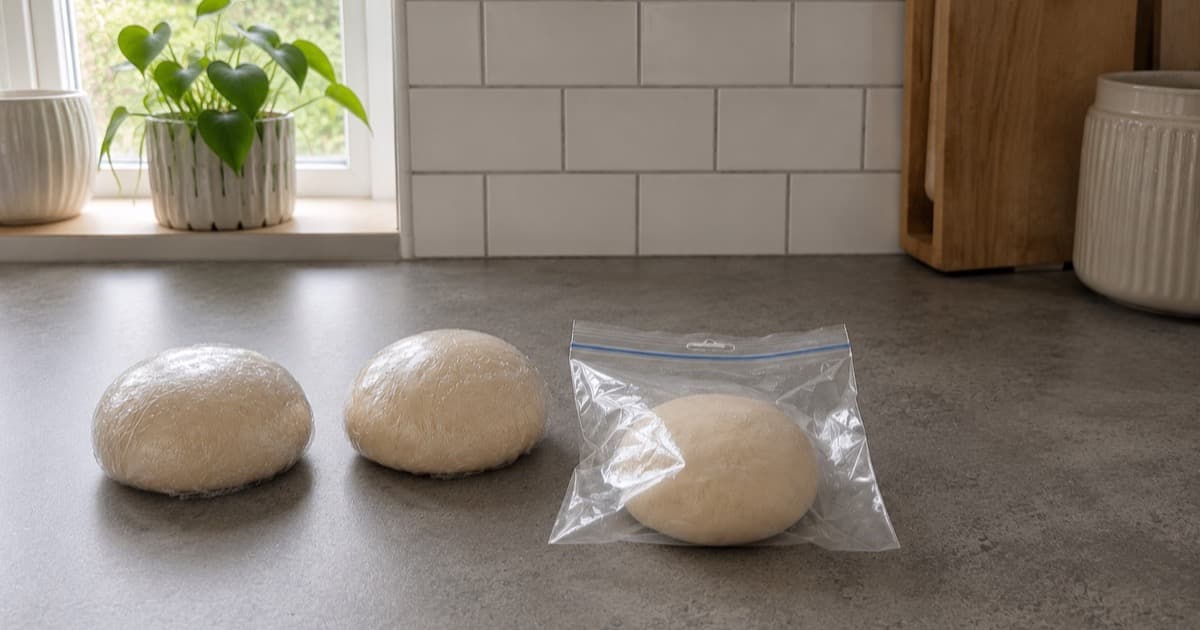
- Pack it airtight. Once the balls are firm, wrap them in film or put them in a zip-top bag. Remove most of the air, but leave a little slack so the ball isn't squashed.
- Dry the condensation. If moisture has collected in the bag, wipe it off before freezing. Otherwise it turns to frost, which makes the dough sticky after thawing.
- Label with the date. That way you know which portions to use first.
- Keep the temperature steady. A freezer that is opened often and swings in temperature shortens the shelf life of the dough.
How to thaw pizza dough
The most important thing is to thaw it slowly and give the yeast time to wake up.
- In the fridge (recommended): move the ball from the freezer to the fridge for 12–24 h. King Arthur gives 6–10 h for dough divided into rounds [3], but a frozen ball is thicker and needs longer. It should be soft all the way through.
- At room temperature: possible, but slower than it looks. The centre of a frozen ball stays cold for a long time, so expect many hours, depending on the kitchen.
After thawing in the fridge, take the ball out for 1–2 h so it warms up and turns elastic. Cold dough stretches badly and tears. Don't speed up thawing with the microwave or hot water, because it overheats the dough and kills the yeast.
If the ball has spread a lot after thawing, you can gently re-ball it 3–4 h before baking: pull the edges under to tighten the surface. Don't knead it again. Kneading thawed dough won't strengthen anything, it will only damage the weakened gluten network. For more on flat and merged balls, see the article on spreading dough.
Plan your fermentation in the Pandough calculator
Recipe: neapolitan pizza
The calculator has no separate freezer step, because freezing stops fermentation. When planning a bake, enter only the fermentation hours before freezing and after thawing, and leave out the time in the freezer.
Most common mistakes
- Loose packing: the dough dries out and picks up freezer smells.
- Freezing over-proofed dough: it loses its spring and its strength for the final rise.
- Too little yeast: the ball rises by only about half after thawing, even after many hours.
- Thawing too fast: the ball tears and is hard to roll out.
- Kneading after thawing: it damages the weakened gluten instead of strengthening it.
- Refreezing: every cycle weakens the dough further.
- Storing too long: the longer it sits, the weaker the yeast and gluten.
Summary
Freezing pizza dough is a simple way to have homemade pizza any time, as long as you don't expect miracles. Freeze shaped balls before they over-proof, give the yeast a reserve for the losses, pack airtight and thaw calmly in the fridge. The result is very good, though fresh dough still has the edge.
FAQ
Formulas to try



Sources
- Autio K., Sinda E., "Frozen doughs: Rheological changes and yeast viability", Cereal Chemistry, 1992. Freezing and thawing reduce the dough's elasticity and relaxation time, while yeast viability after two weeks at -18°C drops only slightly.
- American Society of Baking, "Frozen Dough". Weakening of the dough grows with storage time; the causes named include ice-crystal damage and glutathione released from dead yeast.
- King Arthur Baking, "How to freeze pizza dough", 2024. Freeze after the first rise, up to a month, thaw in the fridge for 6–10 h. Accessed 2026-10-16.
- Teunissen A. et al., "Isolation and Characterization of a Freeze-Tolerant Diploid Derivative of an Industrial Baker's Yeast Strain and Its Use in Frozen Doughs", Applied and Environmental Microbiology, 2002. Freeze-tolerant strains were developed with frozen doughs in mind.
- "Effects of freezing rate and terminal freezing temperature on frozen croissant dough quality", LWT, 2016. Faster freezing gives smaller ice crystals; too low a final temperature (below -20°C) killed more yeast. The study covers croissant dough, not pizza.
What is Pandough?
Pandough is a dough manager that builds a precise plan around your flour, kitchen, oven and schedule.
Try the calculator