
French Baguettes
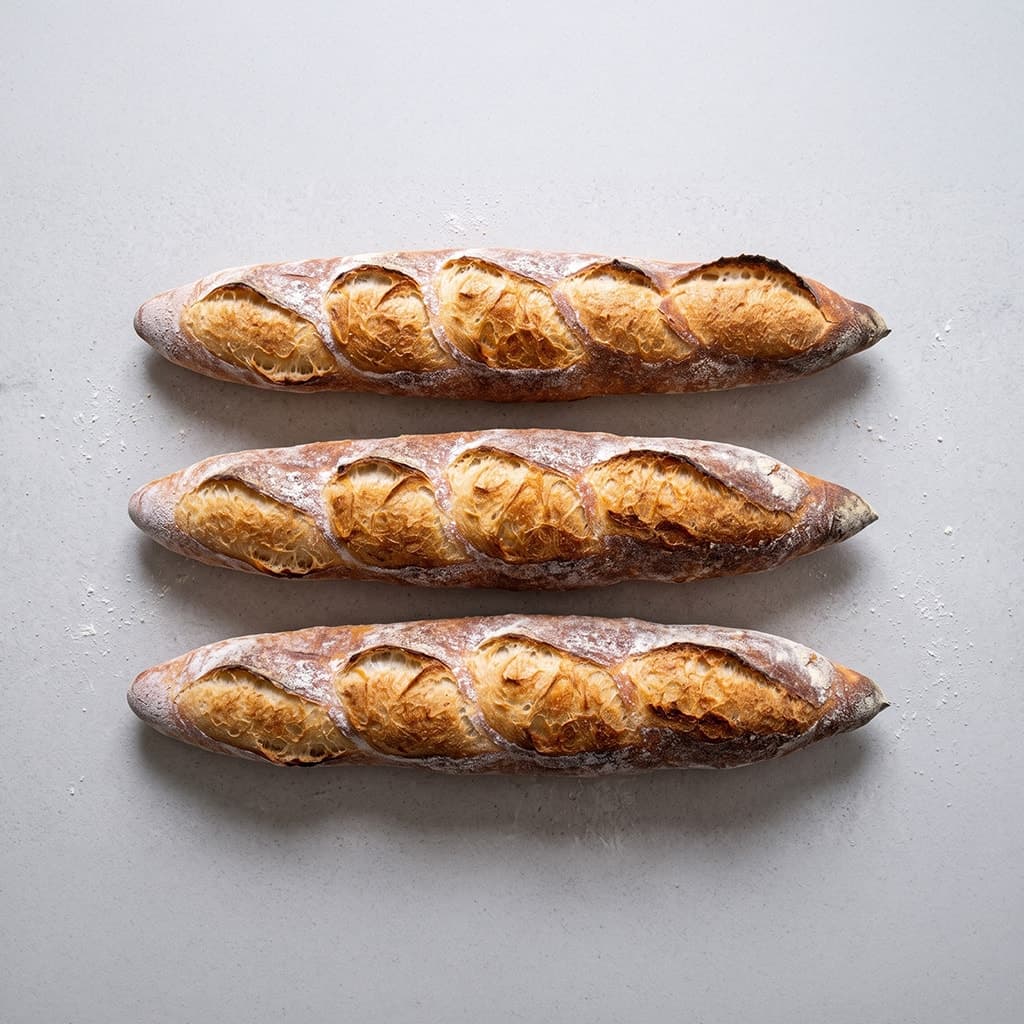
Crispy golden crust with a light, airy crumb. The quintessential French bread.
Baguette is French for wand or stick, and the word is recorded as the name of this bread from 1920. A French decree of 1993 reserves the name "pain de tradition française" for bread that is never frozen and contains no additives. In 2022 UNESCO added the craft and culture of the baguette to its list of the intangible cultural heritage of humanity.
The formula in numbers
- Hydration
- 68%
- Salt
- 2%
- Olive Oil
- none
- Portion
- 3 × 320 g, about 65 cm
- Fermentation source
- Instant Yeast
- Bulk at room temperature
- 4 h
- In the fridge
- 12 h
- Final proof
- 4 h
- Flour strength
- W 200–280
- Flour protein
- 11–13%
How to prepare it
- Flour564 g
- Water384 g
- Salt11 g
- Instant Yeast0.40 g
The yeast is dosed for the fermentation times of this formula. The calculator adjusts it to your flour, your kitchen and your schedule.
- W 200–280
The dough
Four ingredients: flour, water, salt and yeast. No fat and no sugar. Use a bread flour of W 200 to 280.
Too weak a flour gives flat loaves with little structure. A very strong one bakes up tough and chewy.
- 68% water
Mixing
Mix until no dry flour is left, then knead until the dough is smooth. At 68% hydration it is soft but not sticky. Fold it once or twice during the first hours.
The dough temperature after mixing sets the pace of fermentation. The calculator works out the water temperature for you.
- 20 h
Fermentation
4 h at room temperature, then 12 h in the fridge, still in one piece. The long, slow fermentation is where the flavour comes from.
The dough goes into the fridge in bulk, not as shaped loaves. Baguettes that spend the night cold after shaping bake with a thicker crust.
- 4 h
Shaping
Divide the cold dough into 3 pieces of 320 g. Shape each into a short log and let it relax, then fold it and roll it out to length. Proof the loaves seam up on a floured cloth, with a pleat between them. The plan allows 4 h from the fridge to the oven.
A 320 g piece rolls out to about 65 cm, longer than most home ovens are wide. Shape shorter loaves, or set a smaller piece in the calculator.
- 25 min
Baking
Move each loaf to a peel, seam down. Score it with overlapping slashes along its length, holding the blade at a shallow angle. Bake on a hot stone or steel at around 240°C (464°F) for about 25 min, with steam at the start.
Steam keeps the crust soft while the loaf is still rising, so the slashes can open. Pour hot water into a preheated tray as the loaves go in.
The most common mistakes
Wrong:Baking in a dry oven
Right:Add steam as the loaves go in. Without it the crust sets early and the slashes stay shut.
Wrong:Cutting straight across the loaf
Right:Hold the blade at a shallow angle and make overlapping slashes along the length.
Wrong:Rolling out a piece that keeps springing back
Right:Let it rest a few minutes and carry on. A relaxed piece reaches its length without tearing.
Wrong:Taking the loaves out pale
Right:Bake them to a rich golden brown. If they colour too fast, lower the heat and give them the full time.
Recommended flours
Flour for this formula: W 200–280, 11–13% protein. Ranked by fit, then by availability in your country, then by popularity.