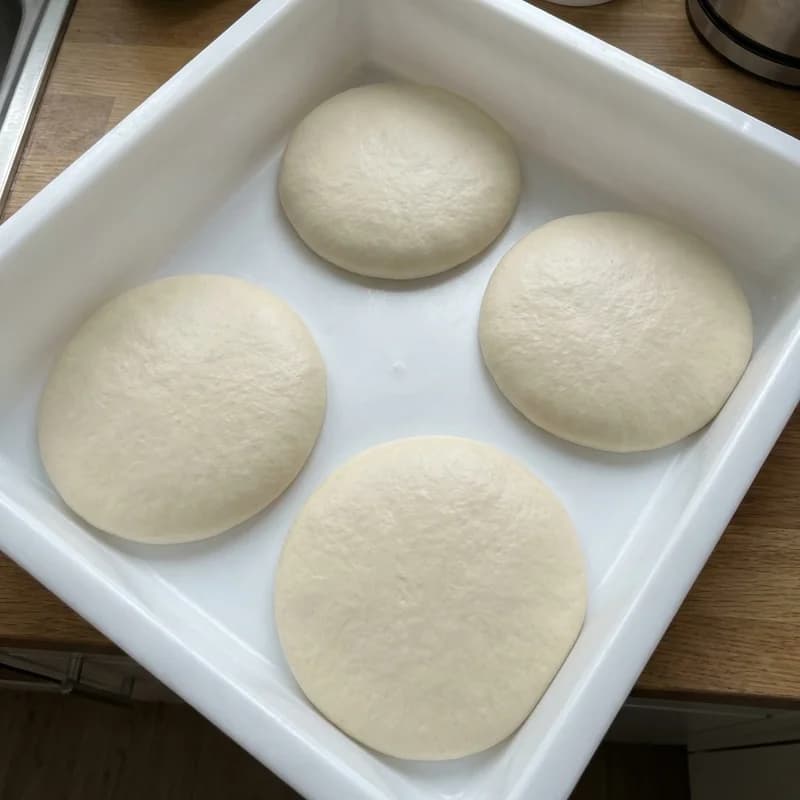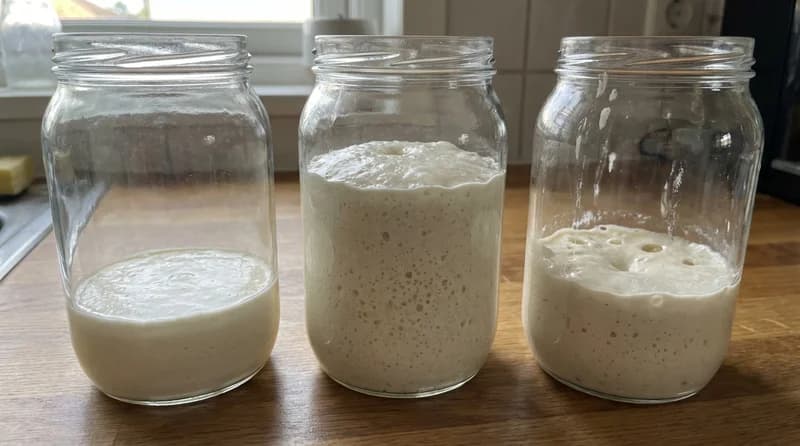

Your Fridge Is Warmer Than You Think
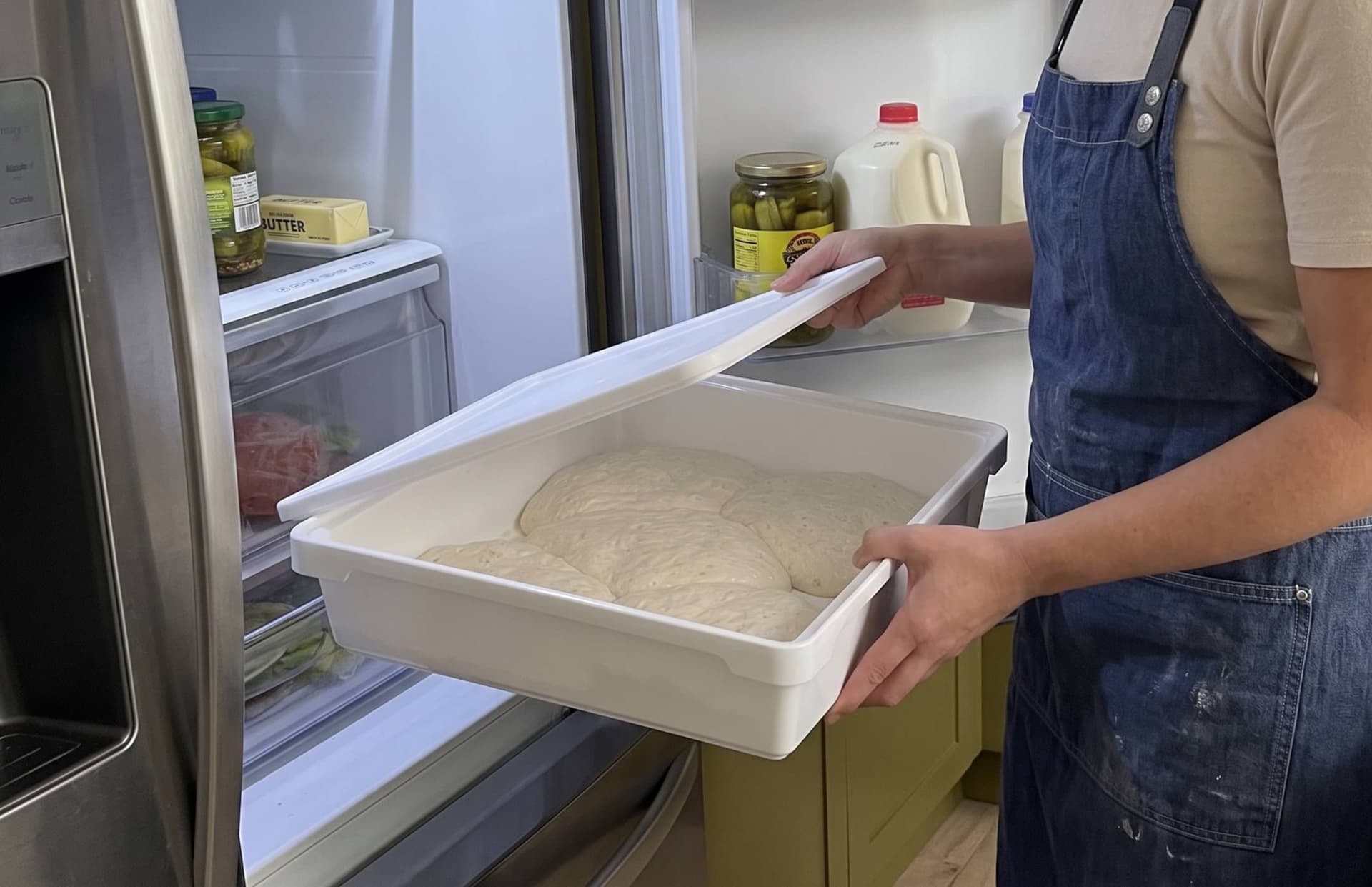
During a long cold fermentation, fridge temperature sets the yeast's pace. Yeast still works at 4°C, just very slowly.1,2 Dough held at a real 3°C finishes in a different place from a plan built around 5°C or 6°C. There is no universal multiplier. Yeast dose, dough temperature after mixing, and time before and after refrigeration matter too.
In short
- Measure the shelf where the dough sits. The fridge setting is not a measurement.
- Yeast keeps working in the fridge, only much more slowly.
- Shelves and doors can differ by several degrees.3
- Air temperature jumps faster than dough temperature.
- Dough often spends most of its time in the fridge, so a few degrees make a major difference.
4°C on the display is not 4°C at the dough
A home fridge is not a laboratory chamber. The compressor cycles. The door opens. Warm groceries go inside.
One study found an average of about 5.1°C near the door, 4.2°C by the inner wall, and 3.4°C in an inner container. The difference between locations exceeded 2°C.3 Measure where the dough sits, then move containers every several hours so they rise evenly.
There is no magic 4°C boundary
Saccharomyces cerevisiae remains active down to about 4°C. Below that, activity drops sharply.1,2 That does not mean it stops completely. The useful question is whether it works fast enough for your planned schedule.
Dough target temperature (DDT) and time before refrigeration matter just as much. That is why the Pandough calculator allows at least 30 minutes before moving dough into the fridge. Yeast needs time to multiply before the process slows down, especially with ice water when DDT falls below 24°C.
PRO TIP Does your dough often over-proof or stay flat in the oven? Measure your fridge. Watch the dough, not the clock.
See how fridge temperature affects your dough
The chart shows 24- and 48-hour fridge plans. It assumes a container with six 250 g pizza dough balls made from Caputo Pizzeria flour. The Pandough engine models yeast activity with Q10 and the dough's thermal inertia.
Fridge temperature
4.0°C
At 5pm this dough is in the peak window.
Dough has thermal inertia
Opening the door quickly raises air temperature.4 A kilogram of dough in a closed container does not warm at the same moment. Its mass makes it respond with a delay.
Pandough models that delay. It matters when you portion the dough. Small balls or loaves cool differently from one large mass. In fermentation settings, choose the real event: “before fridge” or “after fridge”.
The load also changes temperature distribution. Chilled food adds thermal inertia. Tightly packed containers disrupt airflow. Warm groceries add heat.5,6 A measurement in an empty fridge does not describe a weekend when someone opens the door repeatedly. Dough ferments in your home, not in a laboratory.
Plan fermentation with the Q10 and thermal-inertia model
Troubleshooting table
| What you see | What to check | What to do |
|---|---|---|
| Dough barely grew | Fridge is colder than the plan | Take it out earlier |
| Dense, tight dough | Condensation on the walls and/or dough; fridge too cold | Raise the fridge temperature |
| Portions already flat after removal | Fridge was warmer or dough went in too late | Next time measure the fridge and dough after mixing and before refrigeration |
| Looks good out of the fridge, collapses in warmth | Fridge was closer to 5–6°C than 4°C | Shorten the final warm stage or recalculate |
| Brief sensor spike after opening the door | The air warmed | Ignore one spike. Watch the history |
| Temperature is right but dough does not rise | Yeast, DDT, dose, or gluten | Check yeast and post-mix temperature before blaming the fridge |
Measure, then calculate
Put an ordinary thermometer beside the dough. A minimum/maximum thermometer is better because one reading may catch a compressor cycle. Laboratory accuracy is unnecessary. You need to know whether your “4°C” is really around 4°C, 2.5°C, or 6°C.

For automatic logging, Shelly H&T Gen3 is a tested sensor. It measures 0–40°C over Wi-Fi and reports in 0.5°C steps.7 With a PRO plan, you can , so the app warns when dough temperature moves away from the plan. A fridge is a metal box, so check the signal on the dough shelf. Home Assistant can also connect.8
FAQ
Sources
- "Effect of different producing methods on physicochemical and fermentation properties of refrigerated dough", Journal of Food Composition and Analysis, 2023, DOI 10.1016/j.jfca.2023.105268. Accessed 2026-09-09.
- "Yeast Fermentation at Low Temperatures: Adaptation to Changing Environmental Conditions and Formation of Volatile Compounds", Molecules, 2021. Accessed 2026-09-09.
- "Survey on Internal Temperature Distribution in Domestic Food Refrigerators and Freezers", Korean Journal of Food Hygiene and Safety, 2023. Accessed 2026-09-09.
- "Effect of PCM on temperature fluctuation during the door opening of a household refrigerator", International Journal of Green Energy, 2017, DOI 10.1080/15435075.2016.1261705. Accessed 2026-09-09.
- James, S. J., Evans, J., "The temperature performance of domestic refrigerators", International Journal of Refrigeration, 1992, DOI 10.1016/0140-7007(92)90047-X. Accessed 2026-09-09.
- "Thermal and Energy Evaluation of a Domestic Refrigerator under the Influence of the Thermal Load", Energies, 2019. Accessed 2026-09-09.
- Shelly Europe, "Shelly H&T Gen3", current manufacturer specifications and measuring/reporting documentation. Accessed 2026-09-09.
- Home Assistant, "Shelly" integration documentation, version current on 2026-09-09.
- EFSA, "Food poisoning" and "Proper food handling", current consumer food-safety guidance. Accessed 2026-09-09.
* As an Amazon Associate, Pandough earns from qualifying purchases.
What is Pandough?
Pandough is a dough manager that builds a precise plan around your flour, kitchen, oven and schedule.
Try the calculator