
Ciabatta
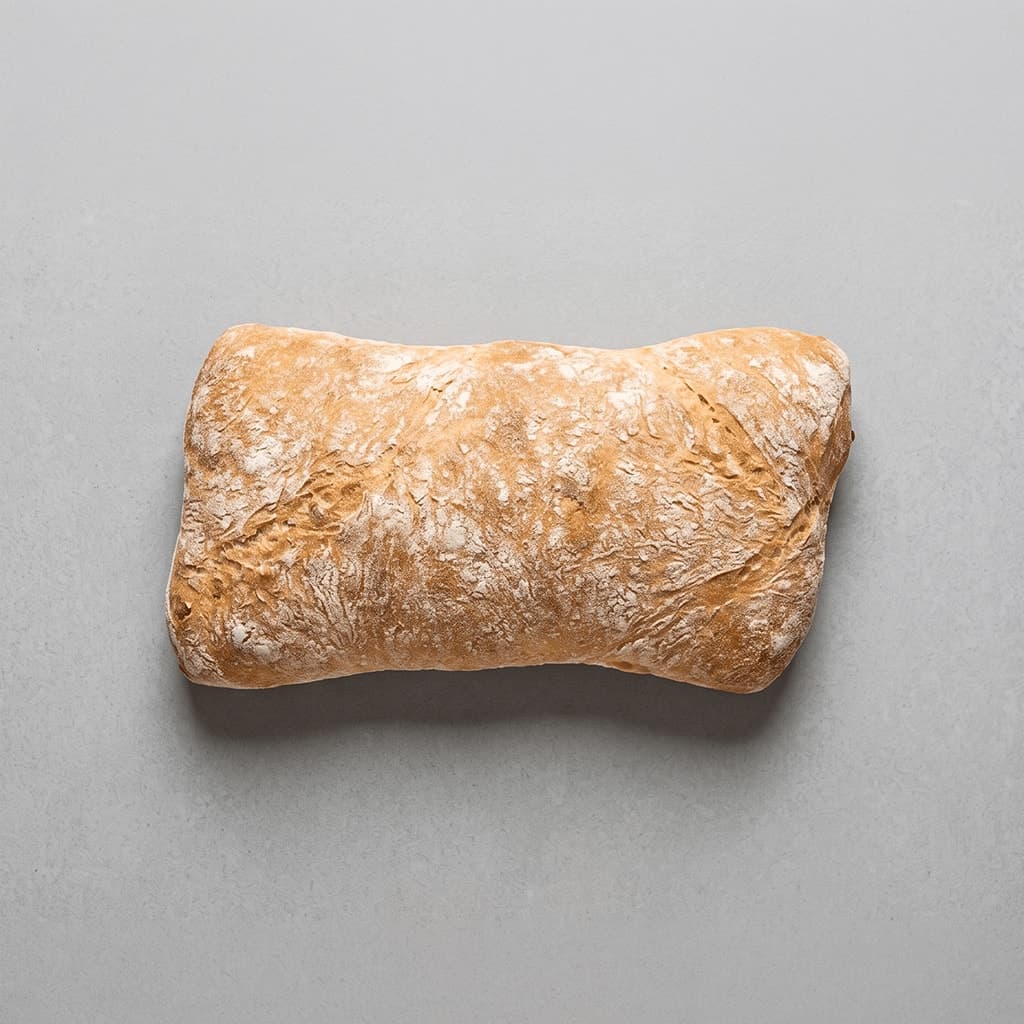
Slack, high-hydration Italian slipper loaf. Wet dough handled with folds instead of kneading, giving a thin crackly crust and a wide-open, glossy crumb.
Ciabatta is younger than it looks. Arnaldo Cavallari, of the Molini Adriesi mill in Adria, in the Veneto, created it in 1982 as an answer to the French baguettes that had become popular for sandwiches in Italy. The name means slipper, after the flat shape of the loaf.
The formula in numbers
- Hydration
- 78%
- Salt
- 2%
- Olive Oil
- none
- Portion
- 3 × 400 g
- Fermentation source
- Instant Yeast
- Bulk at room temperature
- 3 h
- In the fridge
- 13 h
- Final proof
- 2 h
- Flour strength
- W 270–330
- Flour protein
- 12–14%
How to prepare it
- Flour666 g
- Water519 g
- Salt13 g
- Instant Yeast0.51 g
The yeast is dosed for the fermentation times of this formula. The calculator adjusts it to your flour, your kitchen and your schedule.
- W 270–330
The dough
Flour, water, salt and yeast. There is no oil in this dough. With this much water you need a strong flour, W 270 to 330.
A weak flour cannot hold the open crumb. The dough spreads flat and bakes dense.
- 78% water
Mixing
At 78% hydration the dough is slack and sticky. Mix it until it holds together, then build its strength with folds. Wet your hand, lift one side of the dough, stretch it up and fold it over. Work your way round the container.
Do not add flour to make the dough easier. The water is the point of this bread.
- 18 h
Fermentation
3 h at room temperature, with a few rounds of folds, then 13 h in the fridge.
Cold dough is much easier to cut and move. Ferment it in a rectangular container and it tips out already in shape.
- 2 h
Shaping
Flour the bench heavily and tip the dough out without pressing the gas from it. Cut it into 3 pieces of about 400 g, in as few cuts as you can. Lay them on a floured cloth for 2 h.
Ciabatta is cut, not shaped. Every extra touch costs you holes in the crumb.
- 25 min
Baking
Lift each piece from both ends and stretch it gently as you move it to the peel. Do not score it. Bake on a hot stone or steel at around 240°C (464°F) for about 25 min, with steam at the start.
The floured surface cracks open by itself in the oven.
The most common mistakes
Wrong:Adding flour until the dough stops sticking
Right:Keep the water. Handle the dough with wet hands on a well-floured bench.
Wrong:Pressing the dough flat before you cut it
Right:Tip it out and leave it as it falls. The gas you keep becomes the open crumb.
Wrong:Using an ordinary weak flour
Right:Pick a flour of W 270 to 330. A weaker one cannot hold 78% water.
Wrong:Baking in a dry oven
Right:Add steam as the loaves go in, so the crust stays soft while they rise.
Recommended flours
Flour for this formula: W 270–330, 12–14% protein. Ranked by fit, then by availability in your country, then by popularity.