
A Clearer Fermentation View, Offline Planning & Live Sensors
This release makes one of the hardest parts of baking easier to read: where your dough is now, where it is heading, and how much room you have before it goes too far.
It also brings the calculator offline and makes Pandough's hardware temperature sensor support publicly available for the first time.
See Fermentation as a Journey
The calculator now gives you two complementary ways to understand fermentation.
The Fermentation Duration view follows the full journey from mixing to baking. It shows when your flour is still developing, when it reaches its best window, and when extra time starts costing dough strength.
The Flour Terrain view focuses on the trade-off home bakers feel at the bench: more fermentation develops flavor and extensibility, but pushing too far can leave the dough weak, sticky, and difficult to shape.
Both views respond to your flour, temperatures, preferment, schedule, and yeast. You can scrub through the timeline to see how the dough is expected to change hour by hour.
Explore the New Fermentation View
Recept: neapolitan pizza
Adjust Yeast Without Losing Your Plan
Many home bakers already have a schedule that fits their day. They want to test a familiar yeast dose without the calculator moving their mixing or bake time.
Manual yeast adjustments now work that way. Your schedule stays where you put it, while the fermentation view shows whether the dough is likely to mature earlier or later. The manual range is also wider for bakers who use unusually small or large doses.
Returning to the automatic recommendation is still one tap away.
More Dependable Dough Calculations
We corrected several edge cases that mattered most in recipes with poolish, biga, oil, or sugar.
Baker's percentages now consistently use all the flour in the recipe, including flour inside a preferment. Ingredient totals, yeast previews, and shopping quantities therefore stay aligned. Preferment yeast is handled more carefully too, with a warning if its dose cannot fit the formula.
We also tightened the connection between the schedule, warnings, and fermentation view. The red zone you see is now the same boundary used by the advice that explains it.
Keep Planning When the Internet Drops
Once you have opened the calculator online, Pandough can keep its working shell, your current draft, and a useful selection of flours available on the device.
That means a weak kitchen signal, a train journey, or a temporary connection problem no longer has to stop you checking quantities or continuing a bake plan. When you reconnect, the normal online experience returns automatically.
For the best offline fallback, open the calculator and select the flours you use most while you still have a connection.
Live Temperature Sensors Are Now Public
Temperature sensor support existed quietly before this release. It is now available from the calculator for PRO bakers, with guided setup and sensor management built in.
The tested option is the Shelly H&T Gen3, a battery-powered WiFi temperature and humidity sensor. Pandough can also receive readings from Tasmota, Home Assistant, and other devices that can send readings to a web address.
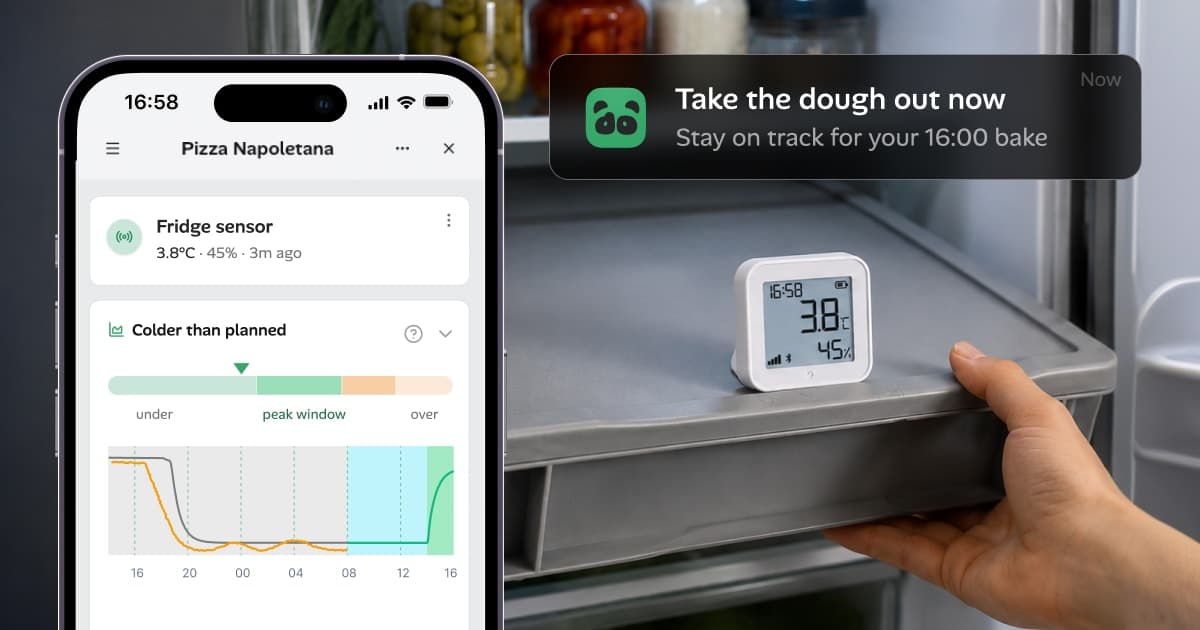
Place one sensor with the dough as it moves between the counter and fridge, or use separate sensors for each space. Pandough can use the real readings in your bake, show when conditions drift from the plan, and send useful alerts to your phone or watch.
For example, if the fridge is warmer than expected, Pandough can tell you before the dough reaches its peak too early.
One practical note: fridges are metal boxes, so WiFi range varies. Test the connection in your own kitchen before relying on unattended alerts.
Smaller Improvements
- The calculator stays smoother while dragging sliders and exploring fermentation time.
- Graphs keep their position more reliably while you scrub or change the visible range.
- Schedule controls, flour links, temperature inputs, and manual yeast settings behave more consistently.
- Long schedules no longer repeatedly interrupt free bakers with the same upgrade prompt.
- Development and offline caching were separated more carefully, reducing the chance of stale screens after an update.
This release is less about adding another number and more about making the numbers useful at the moment a baker has to decide: wait, bake, cool the dough, or adjust the plan.