
Focaccia
Olive oil-rich Italian flatbread with a crispy bottom and fluffy interior.
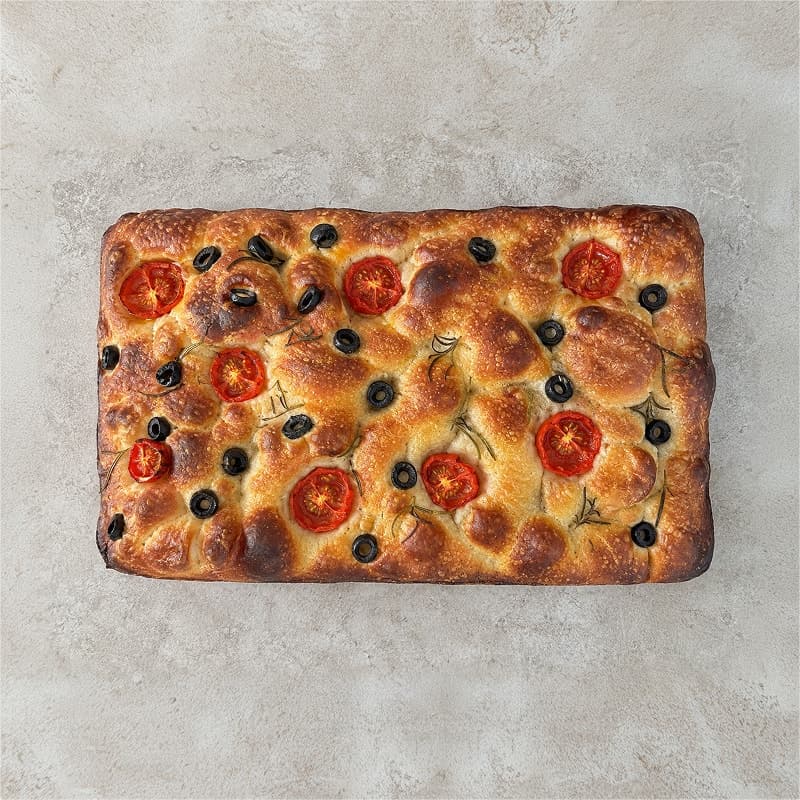
In ancient Rome, panis focacius was a flatbread baked on the hearth, and the word comes from the Latin focus, the hearth. The focaccia of Genoa is known for the finger-sized dimples on its surface, and it is dressed with olive oil and coarse salt.
The formula in numbers
- Hydration
- 78%
- Salt
- 2.5%
- Olive Oil
- 5%
- Portion
- 1 × 800 g, about 25 × 25 cm
- Fermentation source
- Instant Yeast
- Bulk at room temperature
- 6 h
- Final proof
- 2 h
- Flour strength
- W 260–320
- Flour protein
- 11.5–13.5%
How to prepare it
- Flour431 g
- Water336 g
- Salt11 g
- Instant Yeast0.34 g
- Olive Oil22 g
The yeast is dosed for the fermentation times of this formula. The calculator adjusts it to your flour, your kitchen and your schedule.
- W 260–320
The dough
Flour, water, salt, yeast and 5% olive oil. With this much water you need a strong flour, W 260 to 320.
The oil in the dough keeps the crumb soft. More goes into the pan and over the top.
- 78% water
Mixing
At 78% hydration the dough is wet and sticky. Mix it until it is smooth, then work in the oil at the end.
Oil your hands instead of adding flour.
- 6 h
Fermentation
6 h at room temperature, covered. Fold the dough a few times in the first hours to give it strength. This is a same-day dough: there is no fridge in the plan.
Change the hours in the calculator and the yeast dose follows.
- 2 h
Into the pan
Oil the pan well and put in 800 g of dough. Press it outwards with your fingertips. When it springs back, stop, wait a few minutes and press again. Then let it proof in the pan for 2 h, until it is puffy.
800 g fills a square pan of about 25 × 25 cm.
- 15 min
Baking
Pour a little olive oil over the dough and press your fingertips straight down to the pan, all over. Sprinkle with coarse salt and bake at around 245°C (473°F) for about 15 min, until golden.
Turn the focaccia out onto a rack straight away, so the bottom stays crisp.
The most common mistakes
Wrong:Forcing the dough into the corners
Right:Let it relax for a few minutes and press again. It fills the corners as it proofs.
Wrong:A pan that is barely oiled
Right:Oil it well. The oil crisps the bottom and lets the focaccia come out in one piece.
Wrong:Dimpling lightly, on dry dough
Right:Oil the top first and press down to the pan, so the oil pools in the dimples.
Wrong:Leaving the baked focaccia in the pan
Right:Move it to a rack at once. In the pan the bottom steams and goes soft.
Recommended flours
Flour for this formula: W 260–320, 11.5–13.5% protein. Ranked by fit, then by availability in your country, then by popularity.